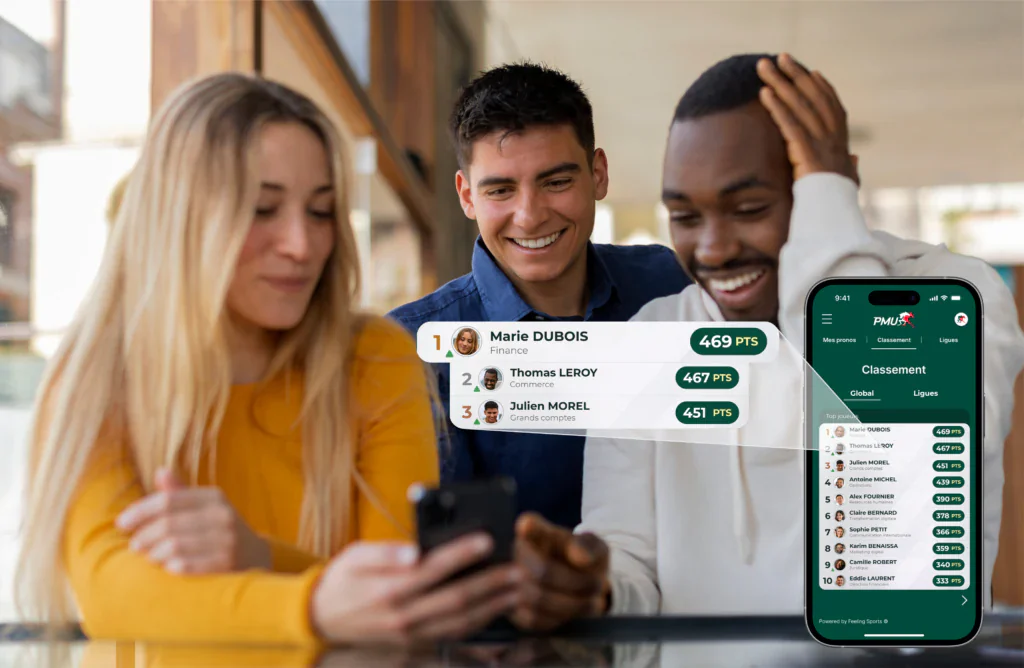
Maintaining employee engagement over time is one of the most tangible challenges faced by HR and internal communications teams. One-off initiatives generate an immediate impact but often struggle to last. Corporate prediction games address this issue in a fairly simple way: they create a regular, inclusive touchpoint centred around an event employees are already following in their personal lives.
Here’s why this format has become an effective internal engagement tool, and how to implement it in practice.
What is a corporate prediction game?
A corporate prediction game is an activity in which employees predict the outcomes of real sporting events. Each participant submits their forecasts before matches, and an internal leaderboard is updated throughout the competition.
The format can be deployed on a dedicated platform or integrated directly into the company intranet. The key requirement is that the experience is easy to use and accessible to everyone.
Why does this format sustain engagement?
What sets this type of activity apart from other team-building formats is one important feature: it unfolds over time. While a one-day internal event creates a strong but isolated moment, a prediction game running across several weeks establishes a shared ritual.
Do participants need to know about sport?
One of the most common objections when presenting this format is: “What about those who don’t follow sport?”
The answer lies precisely in the strength of prediction games: they require no prior expertise. You don’t win because you know every player’s statistics. You simply make a prediction—and chance plays a role.
This has a clear impact in the workplace: prediction games are non-selective. The die-hard fan who watches every match does not necessarily have a better chance than a colleague who watches none. This is what enables the format to bring together very different profiles around the same leaderboard.
Employee engagement often relies on this kind of inclusive mechanism. When everyone can take part without feeling at a disadvantage, participation rates are naturally higher.
Which events work best?
Corporate prediction games work best when tied to events that employees already know and follow. Some concrete examples:
Major international competitions Roland Garros, the Tour de France, the World Cup or the Olympic Games… These events naturally generate excitement that spills over into the workplace. Employees are already discussing them informally. An internal prediction challenge builds on this existing energy rather than trying to create it from scratch.
Domestic leagues over time Ligue 1, the Premier League, or other national competitions can support challenges lasting several months. This format is particularly suited to companies looking for a recurring engagement tool, with a leaderboard that evolves week after week.
What makes a launch successful?
The success of a corporate prediction game doesn’t rely solely on the technical platform. Several elements are key:
- Clear communication at launch: explain the rules simply and show clearly how to participate.
- Easy access: if registration takes too long, some employees will drop out before even starting. A smooth experience is essential.
- A visible leaderboard: this is the engine of engagement. When participants can see where they stand compared to colleagues, they keep coming back.
- Regular reminders: notifications or messages before each matchday help sustain engagement over time.
- A rewarding conclusion: announcing final results, awarding prizes to top players, or sharing highlights. The end of the challenge is just as important as the launch.
Measuring engagement
What distinguishes a well-designed prediction game is measurability. It allows you to track participation rates, monitor engagement over time, and identify the most active users. These insights are valuable for HR teams, enabling them to assess the real impact of the initiative and refine future editions.
This is what makes prediction games a fully-fledged internal engagement tool, rather than just a distraction. They deliver measurable outcomes and can be integrated into a broader employee engagement strategy.
Conclusion
Corporate prediction games are one of the most accessible and effective formats for strengthening connections between employees, particularly during major sporting events. They require no sporting expertise, adapt to organisations of all sizes, and generate measurable engagement over time.